趁热吃Spoken
chèn rè chī
eat it while it's hot
A very common caring phrase from parents and grandparents at the table. 趁 + condition means 'while the chance lasts'.
Related: 趁热喝、趁早、趁机
More about this expression →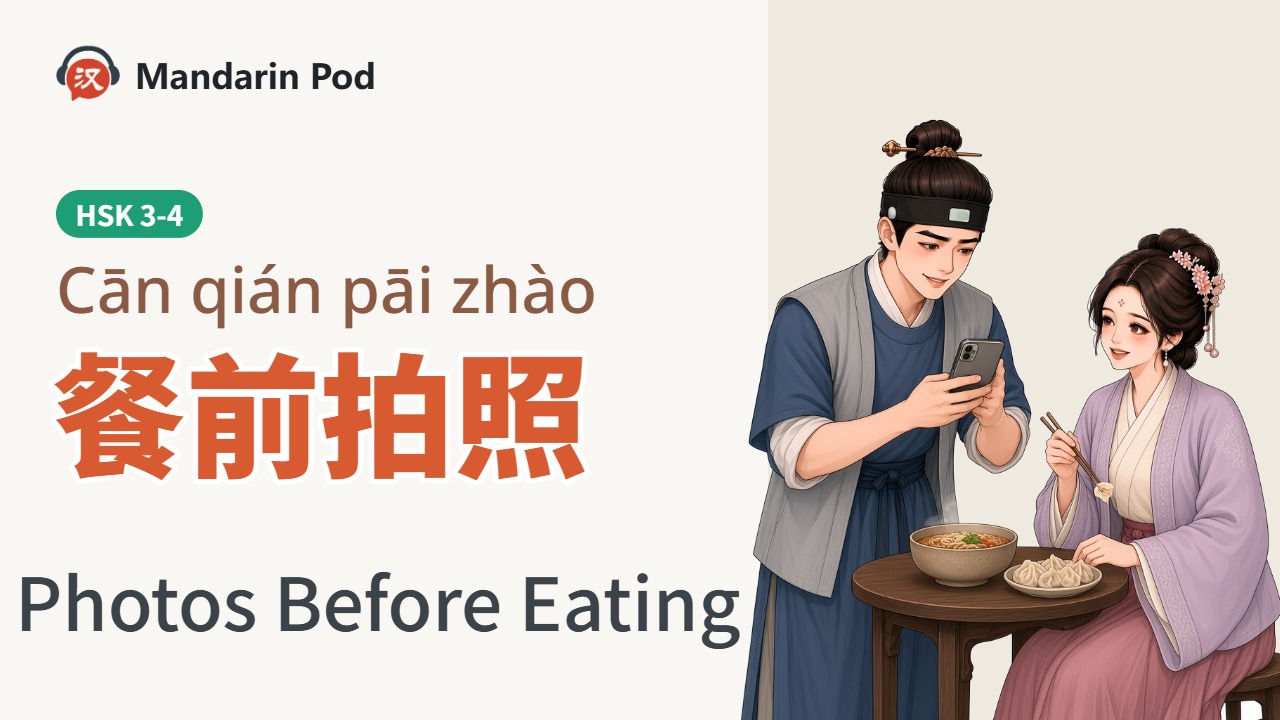
Do You Take Photos Before You Eat? Family Chats and Misleading Pics
Ma Li's mom used to always say "趁热吃,别拍了" (eat it while it's hot, stop taking pictures), but after she learned to use a smartphone, she started taking a photo of all three meals every day and posting them in the family group chat, even a plain bowl of white rice. In this episode, Ma Li and Zhou Yang use simple, natural Chinese to talk about the habit of taking photos before eating: why people want to keep a record, times they were fooled by good-looking photos, why they check reviews before choosing a restaurant, and what to keep in mind when taking photos while eating with others. The episode is also full of heartwarming little stories: Zhou Yang's 82-year-old grandma takes photos of the tomatoes and cucumbers she grows herself, always captioned "趁热吃"; Ma Li's dad replies "看起来很好吃" (looks delicious) under every single photo. When family members live far apart, photos let them share meals together. This episode is suitable for learners who already know some basic Chinese and want to practice listening and everyday speaking. Useful words: 趁热吃 (chèn rè chī) eat it while it's hot; 记录一下 (jìlù yíxià) keep a record of it; 好看不好吃 (hǎokàn bù hǎochī) looks good but doesn't taste good; 评价 (píngjià) review; 舍不得 (shěbude) can't bear to; 换个角度 (huàn ge jiǎodù) try a different angle; 家庭群 (jiātíng qún) family group chat; 朋友圈 (péngyouquān) WeChat Moments.
Ma Li's mom used to always say "趁热吃,别拍了" (eat it while it's hot, stop taking pictures), but after she learned to use a smartphone, she started taking a photo of all three meals every day and posting them in the family group chat, even a plain bowl of white rice. In this episode, Ma Li and Zhou Yang use simple, natural Chinese to talk about the habit of taking photos before eating: why people want to keep a record, times they were fooled by good-looking photos, why they check reviews before choosing a restaurant, and what to keep in mind when taking photos while eating with others. The episode is also full of heartwarming little stories: Zhou Yang's 82-year-old grandma takes photos of the tomatoes and cucumbers she grows herself, always captioned "趁热吃"; Ma Li's dad replies "看起来很好吃" (looks delicious) under every single photo. When family members live far apart, photos let them share meals together. This episode is suitable for learners who already know some basic Chinese and want to practice listening and everyday speaking. Useful words: 趁热吃 (chèn rè chī) eat it while it's hot; 记录一下 (jìlù yíxià) keep a record of it; 好看不好吃 (hǎokàn bù hǎochī) looks good but doesn't taste good; 评价 (píngjià) review; 舍不得 (shěbude) can't bear to; 换个角度 (huàn ge jiǎodù) try a different angle; 家庭群 (jiātíng qún) family group chat; 朋友圈 (péngyouquān) WeChat Moments.
大家好,欢迎来到 Mandarinpod,我是马丽。
Hi everyone, welcome to Mandarinpod. I'm Ma Li.
大家好,我是周扬。
Hi everyone, I'm Zhou Yang.
周扬你看,我妈妈今天早上已经发了两张早饭的照片。周扬你看,我妈妈今天早上已经发了两张早饭的照片。
Zhou Yang, look, my mom has already posted two photos of her breakfast this morning. Zhou Yang, look, my mom has already posted two photos of her breakfast this morning.
一张是包子和豆浆,一张是一碗粥,你妈妈拍得真认真。
One's steamed buns and soy milk, and the other's a bowl of congee. Your mom really puts effort into her photos.
她早上七点就发到家庭群里了,下面还写着“看起来好吃吗”。我醒来一看,群里有十几条消息。
She posted them in the family group chat at seven in the morning, with "Does it look good?" written underneath. When I woke up, there were a dozen or so messages in the group.
今天的话题正好是:吃饭之前,你会先拍照吗?我猜你们家的答案都是会。
Today's topic happens to be: before you eat, do you take a photo first? I'm guessing everyone in your family would say yes.
我自己确实会先拍一张,不过我妈妈以前最不喜欢我吃饭前拍照。
I do take a photo first, but my mom used to really hate it when I took photos before eating.
真的吗?我还以为拍菜是你们家的传统。那你妈妈以前看到你拍照,会说什么?
Really? I thought photographing food was a family tradition for you. So what did your mom used to say when she saw you taking photos?
她每次都说“趁热吃,别拍了”。我还没拍好,她就把筷子放到我手里,说菜都凉了。
Every time she'd say, "Eat it while it's hot, stop taking pictures." Before I'd even finished, she'd put the chopsticks in my hand and say the food was getting cold.
这句话我很熟悉,我奶奶也常说趁热吃。她觉得菜做好了就要马上吃。
That sounds very familiar. My grandma always says "eat it while it's hot" too. She thinks once the food is ready, you should eat it right away.
很多爸妈那一代都这样想。辛苦做了一桌菜,最想看到大家马上吃。
A lot of parents from that generation think that way. After working hard to cook a whole table of food, what they want most is to see everyone dig in right away.
这个我能理解。如果我做好菜,大家都不动筷子一直拍照,我也会着急。
I can understand that. If I made a meal and nobody picked up their chopsticks and just kept taking photos, I'd get impatient too.
可是我拍照是有原因的。好看的菜我想记录一下,以后就能想起那天吃了什么。
But I have a reason for taking photos. When a dish looks nice, I want to keep a record of it, so later I can remember what I ate that day.
记录一下,这个想法挺好。那你什么时候最想拍?是每顿饭都拍,还是只拍特别的饭?
Keeping a record—that's a nice idea. So when do you most want to take photos? Every meal, or only special ones?
现在主要拍特别的时候。比如第一次去的饭店,生日蛋糕,还有自己第一次做成功的菜。
These days it's mainly on special occasions. Like a restaurant I'm going to for the first time, a birthday cake, or a dish I've made successfully for the first time.
自己第一次做成功的菜,我也会拍。上次我做红烧肉,颜色特别好,马上拍了发给妈妈。
A dish I've made successfully for the first time—I'd take a photo of that too. Last time I made red-braised pork, the color was great, so I took a picture right away and sent it to my mom.
你妈妈看到以后怎么说?她是不是很高兴,觉得儿子终于会做饭了?
What did your mom say when she saw it? Was she really happy, thinking her son could finally cook?
她回我“看起来很好吃,回家做给我吃”。可是她不知道,那块肉有点咸,我喝了三杯水。
She replied, "Looks delicious, make it for me when you come home." But what she didn't know was that the meat was a bit salty—I drank three glasses of water.
这就是照片的好处,咸不咸照片上看不出来。你妈妈只看到颜色好看。
That's the nice thing about photos—you can't tell from a photo whether something's salty. Your mom only saw that the color looked good.
没错,照片只能看颜色,不能尝味道。这也最容易让人误会。
Exactly. With a photo you can only see the color, you can't taste the flavor. That's also what makes them so misleading.
说到误会,我真的被照片骗过。以前哪家的菜看起来很好吃,我就去哪家。
Speaking of misleading, I've actually been fooled by photos. I used to go to whichever restaurant had food that looked delicious.
我也常常这样。照片好看的饭店,会让人很想去试试。
I do that a lot too. A restaurant with nice photos really makes you want to go try it.
有一次我看到一家小店,照片里的蛋糕上有很多水果,我马上约朋友周末去吃。
Once I saw a little shop where the cake in the photo had lots of fruit on top, so I immediately made plans with a friend to go that weekend.
听起来很不错,蛋糕上有很多水果,应该很新鲜。那天你们吃得满意吗?
Sounds great—lots of fruit on the cake, it should be really fresh. Were you happy with it that day?
蛋糕跟照片一样漂亮,可是吃了一口,奶油太甜了,水果也不新鲜,真的是好看不好吃。
The cake was just as pretty as in the photo, but after one bite—the cream was way too sweet and the fruit wasn't fresh. It really looked good but didn't taste good.
好看不好吃最让人失望。因为你去之前期待很高,结果味道很一般。
Looking good but not tasting good is the most disappointing. You have high expectations before you go, and then the taste is just so-so.
那天我们还点了一碗面条。照片上面条上有很多肉和菜,到了以后,肉只有两小片。
That day we also ordered a bowl of noodles. In the photo, the noodles had lots of meat and vegetables on top, but when it came, there were only two small slices of meat.
两小片肉也太少了。可能拍照的时候专门放了很多,平时就没有那么多了。
Two small slices of meat is way too little. Maybe they piled on a lot specially for the photo, and normally it's not that much.
我朋友也这么说,她说我们应该拍一张真的样子,让别人看看。
My friend said the same thing. She said we should take a photo of what it really looked like and let other people see.
这个主意不错,真实的照片对别人很有用。那你们后来真的拍了吗?
That's a good idea. Real photos are really useful for other people. So did you actually end up taking one?
拍了,还写了评价。从那以后,我选饭店也会先看别人写的评价,看大家说味道怎么样。
We did, and we wrote a review too. Ever since then, when I choose a restaurant, I first read other people's reviews to see what everyone says about the taste.
这个办法好。评价里有人会说哪个菜好吃,哪个菜太咸,比照片有用多了。
That's a good approach. In reviews, people will say which dishes are good and which are too salty—much more useful than photos.
现在照片只决定我想不想去,评价才决定我去不去。照片好看,评价也好,我才会去。
Now photos only decide whether I want to go, but reviews decide whether I actually go. I'll only go if the photos look good and the reviews are good too.
那你有没有因为看评价,找到特别好吃的店?不能只听失望的故事。
So have you ever found a really great place because of the reviews? We can't just hear the disappointing stories.
有,我家旁边有一家饺子店,照片很普通,可是很多人说饺子特别香,我去吃了,真的很好吃。
Yes. There's a dumpling place next to my home. The photos are really ordinary, but lots of people said the dumplings are super tasty. I went and tried them, and they really are delicious.
这跟蛋糕店正好相反,好吃不好看。看来真正好吃的小店,不一定会花时间拍照片。
That's the exact opposite of the cake shop—tastes good but doesn't look good. Looks like the little places with really good food don't necessarily spend time on taking photos.
现在说回我妈妈。她以前总说“趁热吃,别拍了”,可是去年学会用手机以后,就变了。
Now back to my mom. She always used to say, "Eat it while it's hot, stop taking pictures," but after she learned to use a smartphone last year, she changed.
我猜到了,她也开始拍菜了吧?早上那两张早饭的照片,就是她拍的。
I guessed it—she started taking photos of food too, right? Those two breakfast photos this morning were hers.
你猜对了,而且她比我拍得还多。现在她每天三顿饭都先拍一张,发到家庭群里。
You guessed right, and she takes even more than I do. Now she takes a photo before every one of her three meals a day and posts it in the family group chat.
每天三顿都拍,比你认真多了。你只拍特别的饭,那你妈妈连普通的饭也拍吗?
All three meals every day—way more dedicated than you. You only photograph special meals, so does your mom even photograph ordinary meals?
普通的饭也拍,连一碗白米饭也拍。有一次照片上只有白米饭,下面写着“看起来好吃吗”。
Ordinary meals too, even a bowl of plain white rice. Once the photo was just white rice, with "Does it look good?" written underneath.
一碗白米饭,看起来好吃吗?这个问题真难回答,大家在群里是怎么回复的?
A bowl of white rice—does it look good? That's a really hard question to answer. How did everyone reply in the group?
我爸爸回了“好吃”,我哥哥发了一个大拇指。我回了“米饭很白”,她还挺高兴。
My dad replied "Delicious," and my older brother sent a thumbs-up. I replied "The rice is very white," and she was actually pretty happy.
“米饭很白”这个回答很安全。我很好奇,你妈妈拍照的时候,也会换个角度吗?
"The rice is very white"—that's a very safe answer. I'm curious, when your mom takes photos, does she try different angles too?
会,她现在特别认真。她把盘子摆来摆去,还会换个角度,拍好几张。
Yes, she's really serious about it now. She moves the plates around, tries different angles, and takes several shots.
那你爸爸是不是要在旁边等着?现在应该轮到他说菜都凉了。
So does your dad have to wait on the side? Now it should be his turn to say the food's getting cold.
完全是这样。上次我妈妈拍了五分钟,我爸爸拿着筷子说“趁热吃吧,菜都凉了”。
That's exactly it. Last time my mom spent five minutes taking photos, and my dad sat there holding his chopsticks saying, "Eat it while it's hot, the food's getting cold."
这太好笑了,你妈妈以前说的话,现在变成你爸爸说了。家里的规矩一下子就变了。
That's hilarious. What your mom used to say is now what your dad says. The family rules changed just like that.
我问我妈妈,你以前不是说别拍了吗?她说那不一样,她拍是为了发给亲戚们看。
I asked my mom, didn't you used to say stop taking pictures? She said that's different—she takes them to send to the relatives.
这个理由我能理解。很多爸妈拍菜,是想让孩子知道他们吃得好,身体也好。
I can understand that reason. A lot of parents photograph their food because they want their kids to know they're eating well and they're healthy.
我后来也明白了。看到她的照片,就知道她吃得好不好,我也放心了。
I came to understand that later too. When I see her photos, I know whether she's eating well, and that puts my mind at ease.
这么说,白米饭的照片也有用。至少你知道她按时吃饭了,这对家人很重要。
So even the white rice photo is useful. At least you know she's eating on time, and that matters a lot to family.
现在我每张都认真回复。周扬,你家里人呢?他们吃饭前会拍照吗?
Now I reply carefully to every single one. Zhou Yang, what about your family? Do they take photos before eating?
我爸爸妈妈都不太拍,可是我奶奶最近也学会用手机了,天天发照片。
My parents don't really, but my grandma recently learned to use a smartphone too, and she posts photos every day.
你奶奶也学会了?她多大年纪了?她也会拍菜吗?
Your grandma learned too? How old is she? Does she photograph food too?
她今年八十二岁,她不拍饭菜,她拍院子里自己种的西红柿和黄瓜。
She's eighty-two this year. She doesn't photograph meals—she photographs the tomatoes and cucumbers she grows herself in the yard.
拍自己种的菜,这个很可爱。她发到群里的时候,下面会写什么话吗?
Photographing vegetables she grew herself—that's so cute. When she posts them in the group, does she write anything underneath?
每次都写“趁热吃”。可是西红柿和黄瓜都是生的,根本不用趁热吃。
Every time she writes "Eat it while it's hot." But tomatoes and cucumbers are raw—there's no need to eat them while they're hot at all.
我觉得对你奶奶来说,“趁热吃”已经是一句关心的话了,意思就是好好吃饭。
I think for your grandma, "eat it while it's hot" has become a way of showing she cares. It just means "eat well."
你说得对。她不会说好听的话,可是每次说趁热吃,我都知道她在想我们。
You're right. She's not good with sweet words, but every time she says "eat it while it's hot," I know she's thinking of us.
那你自己呢?平时出去吃饭,你会先拍一张吗?
What about you? When you eat out, do you take a photo first?
我很少拍,因为我总是太饿了。菜一上来我就拿筷子,想起来拍照时,盘子已经空了一半。
I rarely do, because I'm always too hungry. As soon as the food arrives I grab my chopsticks, and by the time I remember to take a photo, the plate's already half empty.
这个我见过。上次一起吃饭,我还在找光线,你已经吃了三个饺子,我只能拍剩下的。
I've seen that. Last time we ate together, I was still looking for good lighting and you'd already eaten three dumplings. I could only photograph what was left.
那天我真的很饿,所以没等你。不过你拍了很久,大家都在等。
I was really hungry that day, so I didn't wait for you. But you did take a long time, and everyone was waiting.
你说得有道理,这是拍菜最大的麻烦。要找光线,要换个角度,拍好了菜都凉了。
Fair point. That's the biggest hassle with photographing food. You have to find the light, try different angles, and by the time you're done, the food's gone cold.
所以一起吃饭的时候,拍一两张就够了,不要让一桌人拿着筷子等。
So when eating with others, one or two shots is enough. Don't make the whole table wait holding their chopsticks.
我同意,现在我跟朋友吃饭,最多拍三十秒。拍太久的话,朋友就说要把我那份吃了。
I agree. Now when I eat with friends, I take thirty seconds at most. If I take too long, my friends say they'll eat my share.
你的朋友说得很对,这个方法很有用。说到底,饭是用来吃的,不是用来看的。
Your friends are absolutely right, that method really works. At the end of the day, food is for eating, not for looking at.
还有一个问题,我手机里有几千张菜的照片,可是我几乎从来不看。
There's another problem. I have thousands of food photos on my phone, but I almost never look at them.
几千张菜的照片,比风景照片还多吧。你会删掉一些吗?还是舍不得删?
Thousands of food photos—probably more than your scenery photos, right? Would you delete some? Or can't you bring yourself to?
我试过删,可是舍不得。看到一张火锅的照片,就想起那天跟谁一起吃,聊了什么。
I've tried deleting them, but I couldn't bring myself to. When I see a photo of hot pot, I remember who I ate with that day and what we talked about.
所以这些照片不只记录了菜,也记录了那一天的心情。这样想的话,留着也挺好。
So these photos don't just record the food, they also record how you felt that day. Thinking of it that way, it's nice to keep them.
对,记录一下是有意义的,只是不要拍太多。那你会拍菜发朋友圈吗?
Right, keeping a record does mean something, just don't take too many. So do you post food photos on WeChat Moments?
我很少发朋友圈,一年可能三四次。我发朋友圈的菜,一般都是特别贵的。
I rarely post on Moments, maybe three or four times a year. The food I post on Moments is usually something really expensive.
我以前去好看的饭店,就发九张照片。现在发得少了,怕朋友们看累了。
I used to post nine photos whenever I went to a nice-looking restaurant. Now I post less, because I'm worried my friends will get tired of seeing them.
九张也太多了。我看到别人发九张菜的照片,一般只看第一张就过去了。
Nine is way too many. When I see someone post nine food photos, I usually just look at the first one and scroll past.
所以现在我只发一张最好看的。说实话,我家庭群里的照片,比我朋友圈的还多。
So now I only post the single best-looking one. Honestly, there are more photos in my family group chat than on my Moments.
因为你妈妈每天发三张,一个月就是九十张。你的朋友圈一年也比不过她一个月。
Because your mom posts three a day, that's ninety a month. A whole year of your Moments can't compete with one month of hers.
真的比不过。有时候我在饭店刚拍好照片,就看到妈妈也在群里发了一张。
It really can't. Sometimes I've just taken a photo at a restaurant, and I see my mom's posted one in the group too.
这个画面很有意思,你们在不同的地方同时拍菜。那你也会把照片发到群里吗?
That's a fun picture—you two photographing food at the same time in different places. So do you post your photos in the group too?
会,我哥哥也会发他的外卖,现在我们的家庭群像一个美食节目。
Yes, and my brother posts his takeout too. Now our family group chat is like a food show.
那你爸爸呢?大家都在发,他是只看不发,还是也会发几张?
What about your dad? With everyone posting, does he just watch, or does he post a few too?
我爸爸不发,他负责回复。每张照片下面他都写“看起来很好吃”,从来不换别的话。
My dad doesn't post—he's in charge of replying. Under every photo he writes "Looks delicious," and he never says anything different.
你爸爸很有耐心,每张都回复。我觉得这是一个很温暖的家庭习惯。
Your dad is very patient, replying to every single one. I think that's a really heartwarming family habit.
我也这么觉得。以前大家住在一起吃饭,现在住得远了,就用照片一起吃饭。
I think so too. We used to all live together and eat together; now we live far apart, so we use photos to eat together.
这个说法很好。拍照本来是个小习惯,现在变成了互相关心的办法。
That's a lovely way to put it. Taking photos started out as a small habit, and now it's become a way to look out for each other.
不过在饭店拍照,也要注意别人。有的人用很亮的灯,会影响旁边的客人。
But when taking photos in restaurants, you should also be considerate of others. Some people use really bright lights, which bothers the customers nearby.
这一点很重要。我见过有人站在椅子上拍菜,旁边的服务员都不知道怎么办。
That's really important. I've seen someone stand on a chair to photograph food, and the waiters nearby didn't know what to do.
站在椅子上不安全,也不礼貌。我觉得坐着拍一张就够了,照片不用那么完美。
Standing on a chair isn't safe, and it's not polite. I think taking one shot sitting down is enough. The photo doesn't need to be that perfect.
我同意,照片拍得一般也没关系,重要的是菜好吃,大家吃得开心。
I agree. It's fine if the photo's just okay. What matters is that the food tastes good and everyone enjoys the meal.
那我们总结一下吧。周扬,你的答案是什么?吃饭之前,你会先拍照吗?
So let's wrap up. Zhou Yang, what's your answer? Before you eat, do you take a photo first?
特别的时候我会拍,比如朋友的生日。平时我还是趁热吃,因为太饿了。
On special occasions I will, like a friend's birthday. Normally I still eat it while it's hot, because I'm too hungry.
我还是会先拍一张,不过拍得很快。拍好马上吃,不让菜凉了,也不让朋友等着。
I'll still take a photo first, but I do it quickly. Once it's taken I eat right away—I don't let the food get cold, and I don't keep my friends waiting.
听起来你找到了一个好办法。好看的照片和热的饭菜,两个都可以有。
Sounds like you've found a good solution. Nice photos and hot food—you can have both.
大家选饭店的时候,也记得看看别人写的评价,不要只看照片,免得好看不好吃。
Everyone, when you're choosing a restaurant, remember to check other people's reviews too. Don't just look at the photos, or you might end up with food that looks good but doesn't taste good.
好,今天的节目差不多录完了。马丽,我好像听到你的手机响了,是不是又有新消息?
Okay, we're just about done recording today's episode. Ma Li, I think I heard your phone go off—another new message?
是我妈妈,她发来一张午饭的照片,西红柿炒鸡蛋和米饭,下面写着“趁热吃”。
It's my mom. She sent a photo of her lunch—tomato and egg stir-fry with rice—with "Eat it while it's hot" written underneath.
你妈妈在提醒你趁热吃吗?可是你还在录节目,还没开始吃午饭呢。
Is your mom reminding you to eat it while it's hot? But you're still recording the show, you haven't even started lunch yet.
问题就在这里,这是她自己的午饭。她让我们趁热吃,可是热的是她的饭,不是我们的。
That's exactly the thing—it's her own lunch. She's telling us to eat it while it's hot, but it's her food that's hot, not ours.
我想她的意思是,她要趁热吃了,大家也别忘了好好吃饭。你快回复她吧,别让她等。
I think what she means is, she's about to eat while it's hot, and everyone else shouldn't forget to eat well either. Hurry up and reply to her, don't keep her waiting.
好,我马上回她“看起来很好吃”。你们呢?吃饭之前,你们会先拍照吗?
Okay, I'll reply to her right now: "Looks delicious." What about you all? Before you eat, do you take a photo first?
你们可以在评论区用中文写一句:我吃饭前一般会先拍一张,因为想发给妈妈看。
You can write a sentence in Chinese in the comments: I usually take a photo before eating, because I want to send it to my mom.
或者写:我从来不拍,因为我喜欢趁热吃。谢谢大家的收听,再见!
Or write: I never take photos, because I like to eat it while it's hot. Thanks for listening, everyone. Bye!
谢谢大家,记得好好吃饭,趁热吃。我们下次见,再见!
Thanks, everyone. Remember to eat well, and eat it while it's hot. See you next time. Bye!
Finished listening? The hosts asked
Chīfàn zhīqián, nǐmen huì xiān pāizhào ma?
Before you eat, do you take a photo first?
Read it first. Answer now, or come back after the steps below.
吃饭之前,你们会先拍照吗?
Chīfàn zhīqián, nǐmen huì xiān pāizhào ma?
Before you eat, do you take a photo first?
Try to use two expressions from this episode, like 趁热吃 or 记录一下.
Read each one and play the line it comes from.
A very common caring phrase from parents and grandparents at the table. 趁 + condition means 'while the chance lasts'.
Related: 趁热喝、趁早、趁机
More about this expression →看起来 + adjective describes an impression from appearance. A safe, polite reply to someone's food photo.
Related: 看起来不错、看上去很好吃、闻起来很香
More about this expression →A compact 好A不好B pattern for contrasting looks and reality. You can flip it to 好吃不好看.
Related: 好吃不好看、中看不中用
More about this expression →一下 softens the verb and makes it sound casual. Often used to explain why you take photos.
Related: 拍下来、留个纪念
More about this expression →换个 + noun means 'switch to another…'. It works literally for photos and figuratively for viewpoints.
Related: 换个地方、换个说法、换个方法
More about this expression →动筷子 means to start eating. Used at shared meals, e.g. 大家快动筷子吧.
Related: 动筷子、开吃、拿起筷子
More about this expression →舍不得 + verb means you're reluctant to do something because you value it. Very common in daily speech.
Related: 舍不得扔、舍不得花钱、舍不得走
More about this expression →A比B + adjective + 多了 means 'much more … than'. Don't put 很 before the adjective in this pattern.
Related: 比……好多了、比……强多了
More about this expression →Used to introduce the basic point or conclusion after some discussion.
Related: 总之、归根到底、其实
More about this expression →放心 means to stop worrying. It's often used about family, e.g. 看到你吃得好我就放心了.
Related: 放心吧、不放心、担心
More about this expression →Swap each word below into the sentence and say the new sentence out loud, or write it. Then check the answers. Can’t type Chinese? Here’s how
Replace the word in brackets to express a different attitude.
我舍不得删这些照片
Replace the adjective in brackets.
评价比照片有用多了
Replace the noun in brackets.
你可以换个角度再拍一张